Molten Salt Reactor Stock: Public IMSR Shares vs. the Copenhagen Atomics Pre-IPO Opportunity
The investment idea in one line: Examine Copenhagen Atomics if you are prepared to invest before a stock may exist.
Last fact-checked: 15 August 2026. Company targets and future dates are identified as such.

There is now a publicly traded molten salt reactor company: Terrestrial Energy, listed on Nasdaq under the ticker IMSR. Copenhagen Atomics is not that stock. It is a privately held Danish reactor developer, and investors may be able to gain exposure before any possible future listing through secondary share transactions or direct capital increases.
That distinction matters. A listed share gives you daily liquidity, public filings and a market price. A Copenhagen Atomics investment gives you earlier access to a different reactor design, but with private-market risk, limited liquidity and no guaranteed IPO.
Molten salt reactor stock:
the direct answer
Is there a listed molten salt reactor stock?
Yes. Terrestrial Energy began trading on Nasdaq as IMSR on 29 October 2025.
Is Copenhagen Atomics publicly traded?
No. Copenhagen Atomics is privately held and has no public ticker.
Can investors buy Copenhagen Atomics shares?
Shares may be available through secondary transactions between shareholders. Direct participation in a capital increase generally starts at EUR 100,000.
Is an IPO confirmed?
No. Copenhagen Atomics has discussed a possible future listing, but no exchange, date, prospectus or offer price has been announced.
What is the next major technical milestone?
The BALDER critical experiment with the Paul Scherrer Institute (PSI) in Switzerland. PSI currently expects initial tests no earlier than 2028, subject to licensing and construction.
Looking for a molten salt reactor stock?
Most people who type “molten salt reactor stock” into Google are not looking for a reactor-physics lecture. They want a company name, a ticker and a way to invest in SMR companies and advanced nuclear reactors.
The clearest public-market answer is Terrestrial Energy, whose shares trade on Nasdaq as IMSR. The company completed its public listing in October 2025 and publishes SEC filings, quarterly results and investor updates.
Copenhagen Atomics sits on the other side of the decision. It has no exchange listing and cannot be purchased through a normal brokerage account. Its shares are private. It creates the possibility of entering before public price discovery, provided shares are available and the investor accepts the risk.
This page compares those two routes without pretending they are the same product.
How to invest in molten salt reactor stocks:
two routes
1. Buy a public MSR stock: Terrestrial Energy (Nasdaq: IMSR)
Terrestrial Energy began trading on Nasdaq under IMSR on 29 October 2025 after completing its business combination with HCM II Acquisition Corp. Its standard IMSR plant design consists of two reactor units with a stated capacity of 822 MWth and 390 MWe.
The company uses standard-assay low-enriched uranium below 5% uranium-235 in its fuel-salt strategy. Its 2026 work includes U.S. Department of Energy pilot projects, fuel-line work, site activity at Texas A&M-RELLIS and licensing work with the U.S. Nuclear Regulatory Commission. Terrestrial Energy said in its second-quarter 2026 results that it was working toward commissioning the first IMSR plants in the early 2030s.
For an investor, the attraction is simple: IMSR is quoted, tradable and covered by public-company reporting. The trade-off is equally clear. The company is already valued in the public market, the share price can move sharply, and commercial reactors are still ahead rather than operating today.
2. Seek private shares before a possible listing: Copenhagen Atomics
Copenhagen Atomics A/S is a privately held Danish company founded in 2014. It is developing a 100 MWth thorium molten salt reactor unit designed around the company’s Onion Core® and a containerised manufacturing concept. As a developer focused on pre IPO nuclear energy, it represents an alternative path to the public markets.
There is no Copenhagen Atomics stock symbol. There is no daily quote. Shares may be available in two ways:
- Secondary transactions: an investor buys existing shares from a current shareholder. There is no fixed minimum for secondary share purchases, although availability depends on willing sellers and the terms of a specific transaction.
- Direct capital increases: professional investors can participate in newly issued shares. The practical starting amount is EUR 100,000.
This is the core proposition: invest before the stock exists. A public listing may happen later, may happen on terms that dilute earlier investors, or may never happen.
Copenhagen Atomics vs.
Terrestrial Energy (IMSR)
Both firms are leading MSR reactor companies developing liquid-fuel systems, but their investment access, fuel strategies, plant architecture and current milestones differ materially.
| Terrestrial Energy | Copenhagen Atomics | |
|---|---|---|
| Company status | Public company listed on Nasdaq | Privately held Danish company |
| Ticker | IMSR | No public ticker |
| Investor access | Ordinary brokerage account, subject to broker and jurisdiction | Secondary share transactions or direct capital increases |
| Liquidity | Public-market trading | Private and potentially illiquid |
| Public reporting | SEC filings, quarterly results and investor relations releases | Private-company reporting and information supplied during due diligence |
| Planned reactor format | Standard plant with two IMSR units, stated at 822 MWth / 390 MWe | 100 MWth reactor unit designed for factory production and containerised delivery |
| Fuel approach | Standard-assay low-enriched uranium below 5% uranium-235 | Initial systems use low-enriched uranium fuel salt with a thorium blanket; the long-term aim is fertile-fuel operation using thorium and, potentially, transuranics as starter material |
| Current evidence | Nasdaq capital, NRC topical-report approvals, DOE pilot agreements, Texas A&M site work and materials testing | Two full-size non-fission prototypes completed, a third in development, extensive molten-salt component work and the BALDER collaboration with PSI |
| Nuclear test path | DOE reactor and fuel-line pilot projects in the United States | Planned critical experiment at PSI in Switzerland, with initial tests expected no earlier than 2028 |
| Commercial timing stated by the company | First IMSR plants targeted for the early 2030s | Commercial 100 MWth units targeted for the early 2030s |
| Commercial activity today | Development-stage public reactor company | Sells molten-salt test loops, purified salts, enriched lithium products and testing services |
| Investor proposition | Listed access to a direct MSR developer | Earlier private exposure before any possible listing |
| Central investor risk | Public-market volatility plus reactor, licensing, funding and schedule risk | Illiquidity plus reactor, licensing, funding, dilution, schedule and no-IPO risk |
Bottom line: IMSR answers the need for a tradable molten salt reactor stock. Copenhagen Atomics answers a different question: can an investor accept private-market risk in exchange for access before a possible future listing?
Why invest
before a stock exists?
A public listing is not the start of a company. It is one financing event in a much longer sequence. For those evaluating a thorium reactor investment, entering private markets allows access before analysts publish price targets, before index funds buy the shares and before every milestone is reflected in a live market price. That earlier entry can be valuable if the company clears technical, regulatory and commercial hurdles. It can also be painful if development slips, later financing arrives at a lower valuation, or no liquid market appears.
The possible advantage
- Exposure before public price discovery
- Access to a reactor architecture that is not represented by IMSR
- A direct position in Copenhagen Atomics rather than a broad nuclear fund or supplier
- Potential participation in value creation tied to prototype, licensing, fuel-cycle and manufacturing milestones
The price of that advantage
- No daily market price
- No guaranteed buyer for the shares
- Long and uncertain holding periods
- Possible dilution in later financing rounds
- Less frequent disclosure than a Nasdaq-listed issuer
- No guarantee of an IPO, commercial reactor or positive return
- A real possibility of partial or total loss
An investor should treat the phrase “pre-IPO” as a description of private ownership before a possible listing, not as a promise that a listing will occur.
What exactly is
Copenhagen Atomics?
Copenhagen Atomics was founded in 2014 by Thomas Jam Pedersen, Peter Szabo, Thomas Steenberg and Aslak Stubsgaard. The company is based in Kastrup, Denmark, close to Copenhagen Airport. Its team page reports more than 80 engineers and scientists in 2026, while its main site describes an 11,000 m² research and development facility.
The company’s planned fourth-generation nuclear reactor unit has a thermal output of 100 MWth and is designed to deliver heat at 550°C. It uses a thermal neutron spectrum and unpressurised heavy water as moderator. Copenhagen Atomics intends to manufacture reactor units in factories rather than assemble the reactor system piece by piece at the plant site.
The technology page explains the staged fuel plan. Early test and commercial systems are intended to use low-enriched uranium fuel salt with thorium in a separate blanket. The longer-term objective is a fertile-fuel system that maximizes thorium energy by breeding fissile material and potentially using transuranic material from spent nuclear fuel as starter fuel.
Those are company plans, not completed commercial performance. No Copenhagen Atomics reactor has yet reached nuclear criticality.
Hardware first:
what Copenhagen Atomics has built already
Nuclear startups often begin with drawings, simulations and regulatory presentations. Copenhagen Atomics has taken a more physical route.
There are two completed full-size non-fission reactor prototypes and a third prototype under development. These systems do not prove nuclear operation, but they let the engineering team work on pumps, piping, heat transfer, salt purification, seals, flanges, instrumentation, controls and maintenance at relevant temperatures and scale.
In 2025, the European Innovation Council selected Copenhagen Atomics for EIC Accelerator blended-finance support. That selection is external validation of the development program.
Copenhagen Atomics also develops and sells equipment used by external reactor developers and laboratories. Its molten salt product portfolio includes:
- Pumped molten salt test loops for materials and component testing
- Purified fluoride and chloride salts
- Enriched lithium products, including lithium-6 and lithium-7 supplied as lithium fluoride
- Molten salt testing services for corrosion, thermal cycling, materials and components
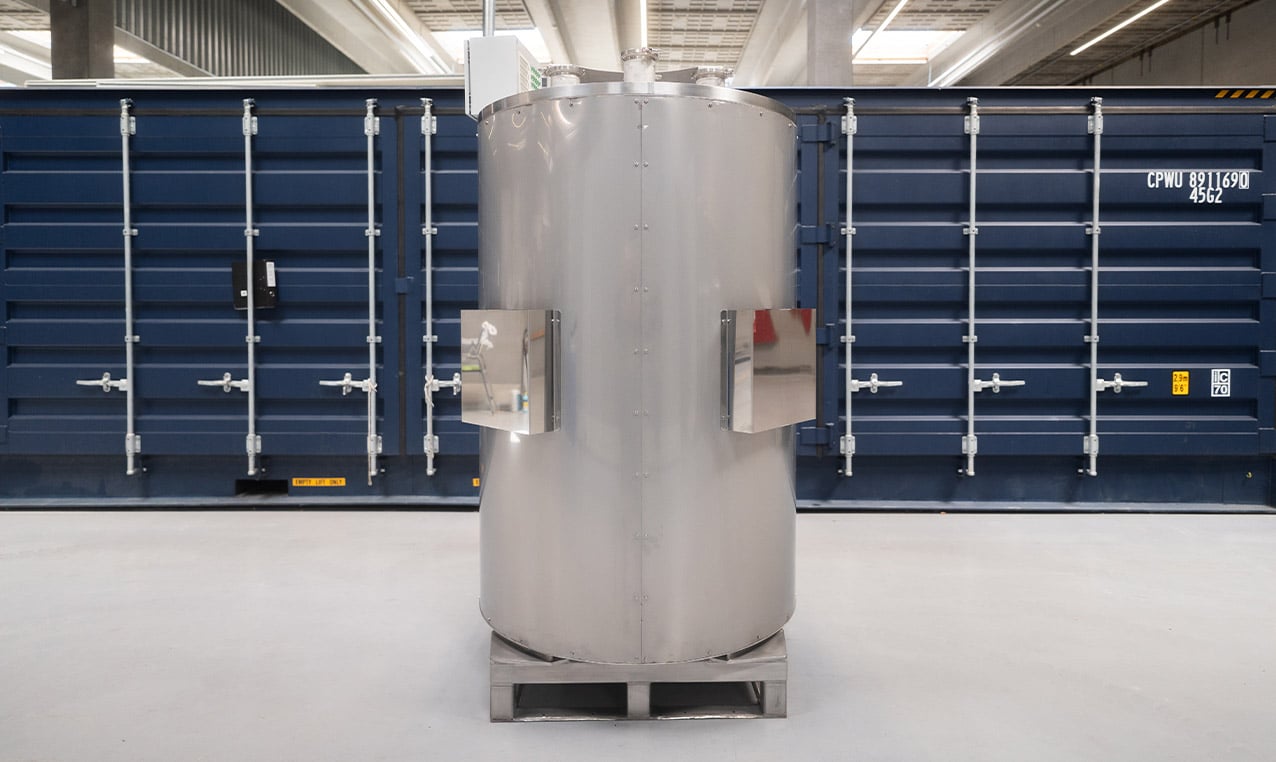
- Molten salt storage and transport tanks
This commercial activity does two useful things. It generates revenue before reactor sales begin, and it places Copenhagen Atomics hardware in contact with customers, laboratories and other nuclear programmes. It does not remove the much larger task of proving a nuclear reactor and securing approval for commercial deployment.
The reactor thesis
in plain English
A liquid-fuel molten salt reactor places fissile material in a salt mixture that circulates through the reactor system. The salt carries the fuel and transfers heat. Because the fuel salt does not need to be kept under the very high pressure used in conventional water-cooled reactors, the plant architecture can avoid some pressure-driven accident scenarios.
Copenhagen Atomics combines that liquid-fuel concept with its Onion Core® design, heavy-water moderation and a separate thorium blanket. The planned commercial unit is rated at 100 MWth. Several units could be installed at one site, with the site owner providing buildings, turbines, grid connection, licensing, staffing and other balance-of-plant systems.
The long-term fuel thesis is more distinctive than the container. Copenhagen Atomics aims to keep the fuel salt in the reactor for long periods, breed fissile material from fertile thorium and remove selected fission products during operation. The company also aims to use transuranics from spent nuclear fuel as starter material in a later fuel cycle.
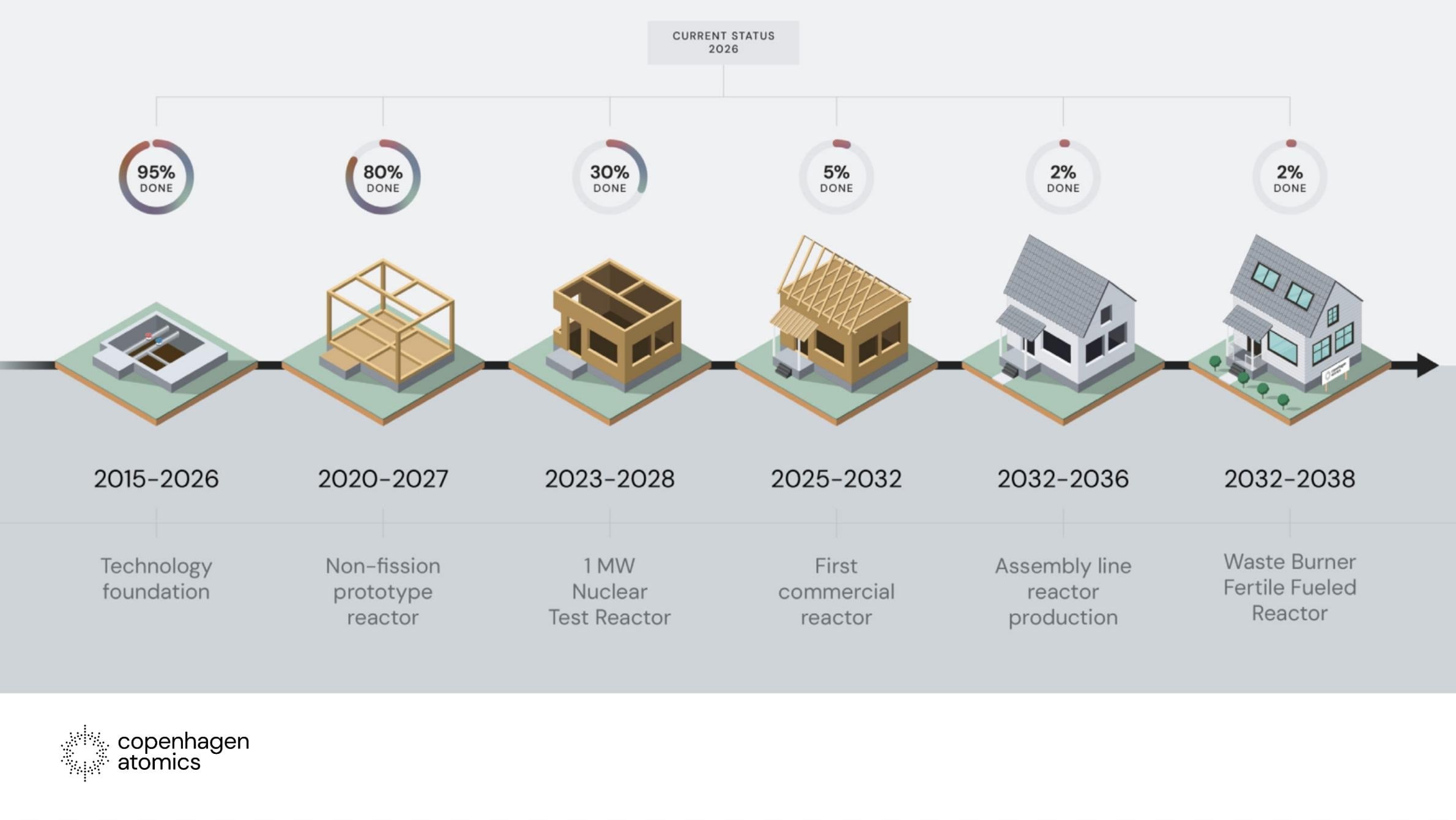
Each of those steps demands evidence from chemistry, materials testing, reactor physics, operations, safeguards and licensing. The first critical experiment is therefore the milestone investors should watch most closely.
The 2028 milestone that matters:
BALDER at PSI
Copenhagen Atomics and the Paul Scherrer Institute are preparing the BALDER project in Switzerland. PSI describes it as a critical experiment in a new nuclear test facility with low hazard potential.
The planned experiment is the same physical size as the later commercial reactor unit, but its thermal output is limited to one hundredth of the planned commercial output. Earlier reference planning used approximately 1 MWth for up to 30 days. The experiment is intended to use low-enriched uranium fluoride fuel salt and heavy water moderation.
PSI states that the project remains in planning and preparation. An application for the nuclear test facility is expected by the end of 2026, and initial tests are expected no earlier than 2028. The licensing duration cannot yet be estimated reliably.
What a successful BALDER experiment could show
- The reactor can reach and control criticality as predicted
- Neutronic and thermal-hydraulic models match measured behaviour closely enough to guide later design work
- Key structures, systems and components operate in a nuclear environment
- Safety analysis, monitoring and shutdown functions work within the test conditions
- Useful data can be collected on materials and fission products
What BALDER would not prove by itself
- Multi-year commercial reactor life
- 100 MWth operation
- Fleet manufacturing economics
- Commercial capacity factor
- Full fuel-cycle performance over decades
- Final licensing in any commercial market
- A future stock-market listing
That distinction is essential. BALDER could supply measured data on reactor physics, system behaviour and component performance. It would not turn a development company into a mature utility overnight.
How Copenhagen Atomics
generates revenue today
Copenhagen Atomics already earns commercial revenue from products and services sold to nuclear research institutes, fusion programmes, universities and reactor developers.
Its current offer includes molten salt loops, purified salts, enriched lithium and paid testing work.
For investors, the significance is practical rather than cosmetic. Product sales force a technical company to manufacture, deliver, support and improve real equipment. They also provide customer data and industry relationships before reactor deployment.



How to invest in
Copenhagen Atomics before an IPO
You cannot buy Copenhagen Atomics through Nasdaq, the London Stock Exchange, SIX Swiss Exchange or a standard online broker. There is no Copenhagen Atomics ticker. There are two private-market routes.
Secondary shares from existing shareholders
Existing shareholders may sell shares to new investors. There is no fixed minimum amount for secondary purchases. A transaction still depends on the availability of a seller, the share class, the agreed price, applicable law and the company’s process.
Direct participation in a capital increase
A direct investment places new capital into Copenhagen Atomics in exchange for newly issued shares. The practical starting point for this route is EUR 100,000; most direct investors are high-net-worth individuals and family offices. The current availability, valuation, share class, shareholder rights, transfer restrictions and legal documentation must be checked for the specific transaction. They are not fixed by this page.
Share availability is subject to applicable law, investor eligibility, company approval and transaction-specific documentation. This page is not a prospectus or a binding offer.
When could Copenhagen Atomics become a public stock?
There is no fixed IPO date. Copenhagen Atomics views a public listing as a more natural step once its first test reactor is operational, or potentially after initial commercial units have logged meaningful operating hours. Public reports from May 2026 discussed internal preparations and company interest in the U.S. market—where listed nuclear developers have attracted substantial valuations.
However, none of this constitutes an announced flotation. Consequently, a pre-IPO investor should understand that they are not buying a guaranteed, scheduled listing. They are acquiring private shares in a reactor developer that will evaluate a potential IPO only after clearing critical technical and operational milestones.
Which route fits
which investor?
You need daily liquidity and public filings
Terrestrial Energy’s Nasdaq-listed IMSR shares are the more direct fit. The stock can be traded through participating brokers, and investors receive public-company filings and quarterly reporting.
You accept private-market risk and a long holding period
For exposure to next-generation nuclear technology, Copenhagen Atomics may fit investors who want entry before a possible listing and can tolerate limited liquidity, less frequent disclosure, future dilution and a holding period measured in years.
You want broader nuclear exposure
Listed uranium miners, fuel suppliers, reactor component companies and nuclear utilities offer other forms of exposure. They are not pure molten salt reactor stocks. Their economics depend on much larger businesses than one MSR design.
The risk checklist
- Technical risk: the integrated nuclear reactor has not yet reached criticality.
- Licensing risk: the PSI experiment and any commercial plant require regulatory approval. Applications can be delayed, changed or refused.
- Schedule risk: PSI currently expects tests no earlier than 2028, and commercial dates remain company targets.
- Scale-up risk: a short, low-output experiment cannot prove multi-year 100 MWth commercial operation.
- Materials and chemistry risk: fuel salt, structural materials, corrosion control, fission-product handling and component life must perform under irradiation.
- Funding and dilution risk: reactor development consumes capital. Later rounds may dilute existing shareholders or occur at a lower valuation.
- Liquidity risk: private shares may be difficult or impossible to sell at the desired time or price.
- IPO risk: no public listing is guaranteed.
- Supply-chain risk: specialised salts, enriched lithium, uranium, thorium, nuclear-grade components and qualified suppliers must be secured at scale.
- Commercial risk: customer demand, plant financing, full project cost and reactor economics have not yet been demonstrated through an operating commercial plant.
An investor should be financially able to hold the shares for a long period and absorb a total loss.
Verify Copenhagen Atomics for yourself
A serious investment decision should start with primary sources. Review Copenhagen Atomics’ technology, history, founders, team, newsroom and commercial products. You can also inspect Copenhagen Atomics’ public engineering work on GitHub, watch long-form technical material on YouTube, and follow company updates on LinkedIn.
Invest before the stock exists
Copenhagen Atomics is not a public molten salt reactor stock. That is both the opportunity and the constraint.
If you decide to invest in private nuclear company structures, pre-IPO shares may be available through secondary transactions with existing shareholders. Direct capital increases generally start at EUR 100,000. There is no promised IPO, no guaranteed liquidity and no guaranteed return.
For investors who understand that trade-off, the next step is to ask about current availability and review the detailed investor material.
Factual sources and update policy
Public-company facts about IMSR come from Terrestrial Energy Investor Relations and its Nasdaq listing announcement. BALDER dates and test parameters come from the Paul Scherrer Institute. Copenhagen Atomics share access, milestones, team size, technology and product activity come from the company pages linked throughout this article. The possible IPO discussion is also reflected in public reporting from May 2026.
Future dates, costs, reactor performance and listing plans are targets or forward-looking statements unless a source explicitly records a completed event.
FAQ: Molten salt reactor stock
Is Copenhagen Atomics publicly traded?
No. Copenhagen Atomics is privately held and is not listed on Nasdaq, NYSE, the London Stock Exchange, SIX Swiss Exchange or another public exchange. It has no public stock ticker. Investors cannot buy Copenhagen Atomics through a normal brokerage account.
How can I invest in Copenhagen Atomics?
There are two routes. Investors may buy existing shares through a secondary transaction with a current shareholder, subject to availability and transaction terms. Professional investors may also participate directly in a new share issue, or capital increase. Use the Copenhagen Atomics contact page to ask about current availability.
What is the minimum investment amount?
There is no fixed minimum for secondary share purchases. For direct participation in a capital increase, the practical starting amount is EUR 100,000. The actual amount, price, share class and terms depend on the transaction.
When does Copenhagen Atomics plan to go public?
No fixed date has been announced. A listing is more likely after the first test reactor is operating or after first commercial reactors have operated for some time. Public reporting in May 2026 described interest in a possible listing, particularly in the United States. No exchange, prospectus, offer price or binding IPO timetable has been published.
How is Copenhagen Atomics different from other SMR companies?
Copenhagen Atomics is developing a liquid-fuel, thorium-based molten salt reactor rather than a smaller version of a conventional solid-fuel light-water reactor. Its planned unit is rated at 100 MWth, uses unpressurised heavy water as moderator and is designed for factory production and containerised delivery. Copenhagen Atomics also develops its own salt systems, pumps, purification equipment and fuel-cycle technology. The integrated nuclear design remains pre-commercial.
Is there a publicly listed molten salt reactor company?
Yes. Terrestrial Energy began trading on Nasdaq under the ticker IMSR on 29 October 2025. It is developing the Integral Molten Salt Reactor plant. Other listed nuclear companies may supply fuel, materials or components, but that does not make them direct molten salt reactor stocks.
Why invest in a private MSR company instead of listed nuclear stocks?
A private MSR investment can provide exposure before public price discovery and before a possible listing. The shares are unlisted, there is no public market, and the price is set in a negotiated transaction. The cost is limited liquidity, less frequent disclosure, future dilution risk, a long holding period and no guarantee of an IPO or positive return. Listed nuclear stocks are easier to trade but may already reflect more of the expected value in their market price.
How does Copenhagen Atomics generate revenue today?
Copenhagen Atomics sells pumped molten salt test loops, purified fluoride and chloride salts, enriched lithium products and professional testing services to reactor developers, research institutes, fusion programmes and universities.
What stage of development is Copenhagen Atomics at?
There are two completed full-size non-fission reactor prototypes and a third prototype in development. Copenhagen Atomics is preparing the BALDER critical experiment with the Paul Scherrer Institute. PSI says initial tests are expected no earlier than 2028, subject to licensing and construction. No Copenhagen Atomics reactor has yet reached nuclear criticality or commercial operation.
Who are the current investors in Copenhagen Atomics?
There are more than 200 private investors from 20 countries. The largest positions are held by high-net-worth individuals and family offices and that no single dominant venture fund controls the shareholder base.
What are the key risks of investing in a pre-IPO nuclear company?
The main risks include failure or delay in reactor development, regulatory refusal or delay, cost overruns, the need for further capital, dilution, supply-chain constraints, materials and fuel-cycle problems, weak commercial demand, private-share illiquidity and the possibility that no IPO occurs. An investor can lose part or all of the invested capital.
What milestones does Copenhagen Atomics plan to reach by 2028?
Copenhagen Atomics plans to continue fertile-salt production work, develop further non-fission and subcritical prototypes, and prepare its first critical experiment. The central 2028 target is the BALDER molten salt experiment at PSI in Switzerland. PSI currently expects initial tests no earlier than 2028 and states that the timing depends on licensing, facility construction and commissioning.