
Test salts such as FLiNaK, FLiBe and Chloride Salts. Fuel salts such as UF4 and ThF4. And enriched lithium delivered as LiF.
Copenhagen Atomics makes highly purified fluoride and chloride salts, and is a nuclear-grade enriched lithium supplier providing Li-6 and Li-7 for reactor, fusion and research use.
Salts are provided in purity as low as 20 ppm oxides. Using these purified salts it is possible to significantly eliminate corrosion.
We are providing a number of clean, dry, and pre-melted salts. These salts are:
Highly purified salts
FLiNaK, FLiBe, and Chloride Salts
Fuel salts
Uranium fuel salt (UF4) and Thorium fuel salt (ThF4)
Enriched Lithium
Enriched Lithium Supplier, Li-6 and Li-7 for the fusion and fission industry
Molten salt
Highlights
Ships in one
high-purity
grade

Ships in
volumes of 1 kg
and ton scale

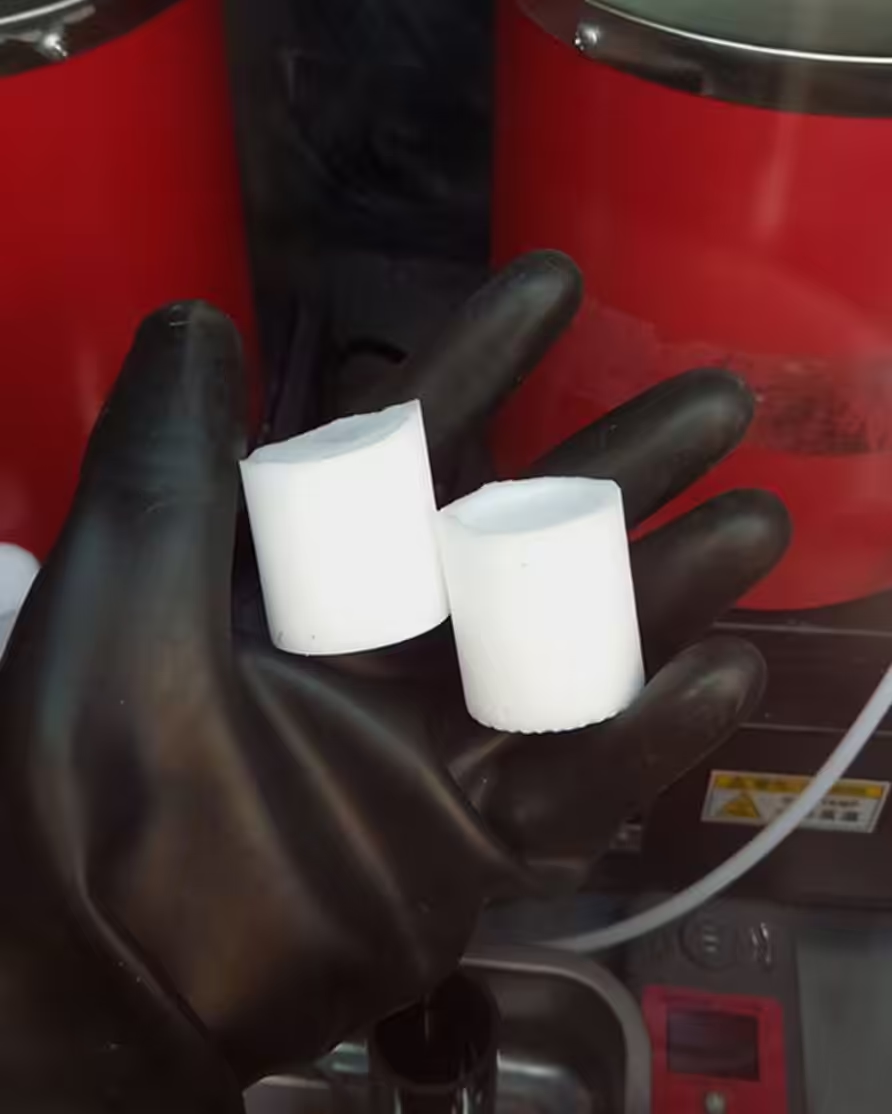
Pre-mixed and pre-melted pellets or tanks

Less impurity
from moisture,
oxides and
metal traces

10 times less
moisture uptake
compared
to powder

Significantly
less corrosion

The molten salts
Introduction
Copenhagen Atomics has developed purification processes which enables control of the amount of metallic and oxygen containing impurities in selected salts, because impurity driven corrosion is one of the main material degradation mechanisms in any molten salt system.
Traditionally, commercially available FLiNaK, FLiBe and Chloride salts come in powder form and needs to be mixed to the eutectic composition, while often containing a large and variable amount of moisture, oxide and metal contaminants.
Therefore, Copenhagen Atomics has developed a commercially available high-purity grade of salts. Tight impurity control and a pre-mixed formulation enable research groups and companies using molten salt to obtain more reliable, consistent data and to reduce corrosion in molten-salt processes.
Purified salt
Through production this undergoes a time consuming purification process to drive out moisture and oxygen from the salt. Purified salt is available in large quantities, intended for large testing requirements or molten salt processes in operation.
Corrosion and Impurities
Copenhagen Atomics has significantly increased the accuracy of measuring impurity in these salts by 10% or more.
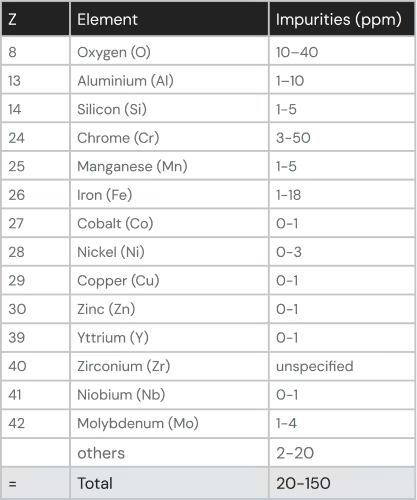
Metal impurity is measured through ICP OES and oxide impurity through electrochemical techniques.
The figure on the right shows the salt’s oxide and metal contaminant levels
Increased accuracy of impurity measurement, leads to increased accuracy of measuring corrosion, as corrosion scales with increased moisture, oxide and metal content.
Corrosion rate decreases substantially with the salts produced by Copenhagen Atomics.
- Corrosion rate induced by Copenhagen Atomics’ purified salt is less than 0.01 mm/year.
- Corrosion rate induced by commercially available salt powder is more than 1 mm/year.
- Corrosion rate in stainless steel 316L at 550 ˚C in static experiments without galvanic effects.
Our highly purified FLiNaK and FLiBe salt shows less than 0.01 mm/year corrosion in SS316L at 550 °C, versus more than 1 mm/year for commercial powder-form salts.
Advantages
of using our salts
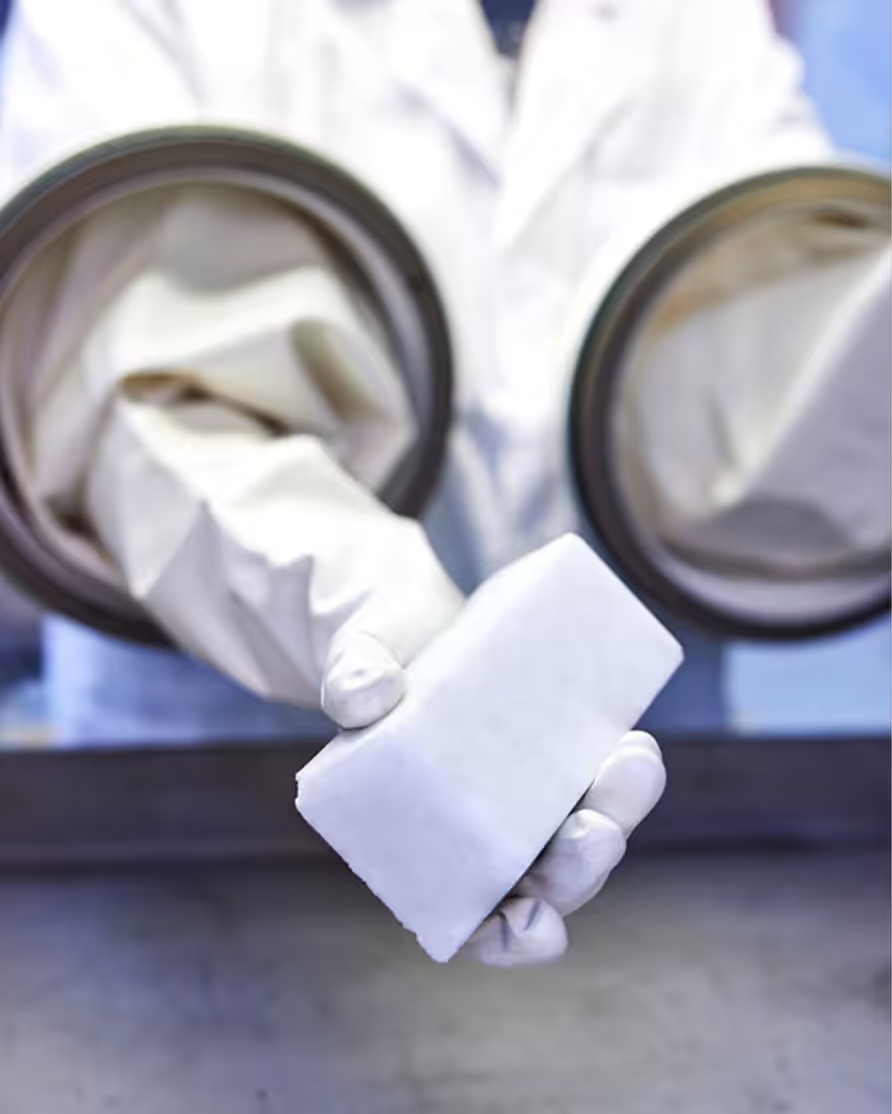
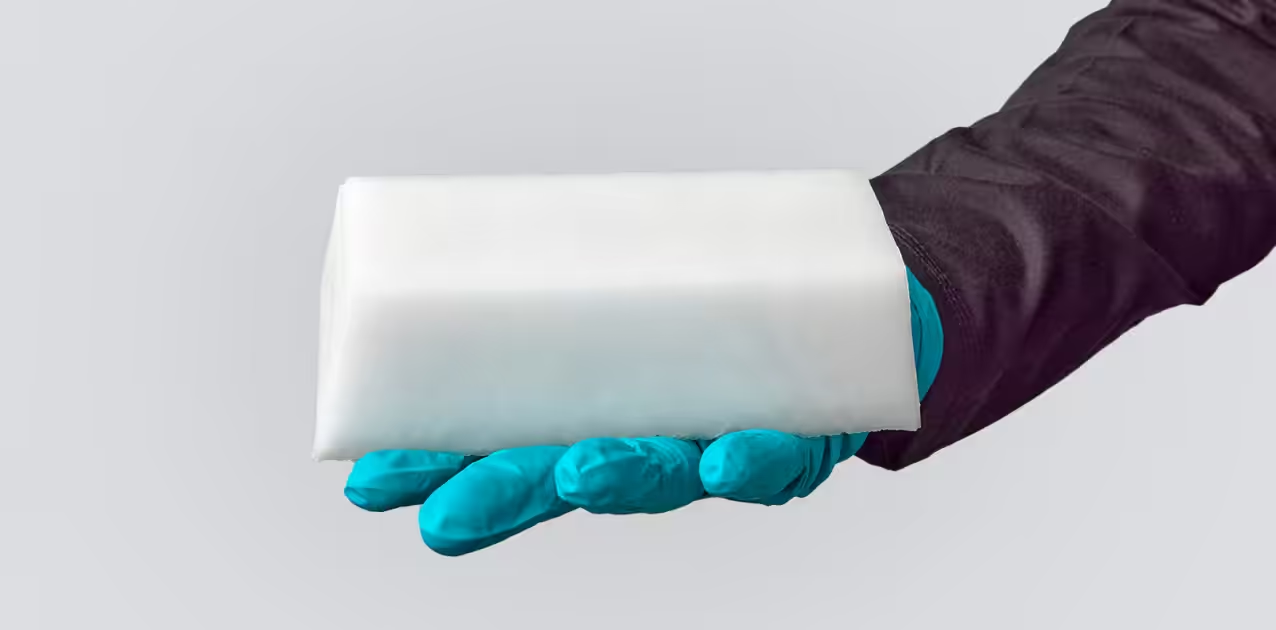
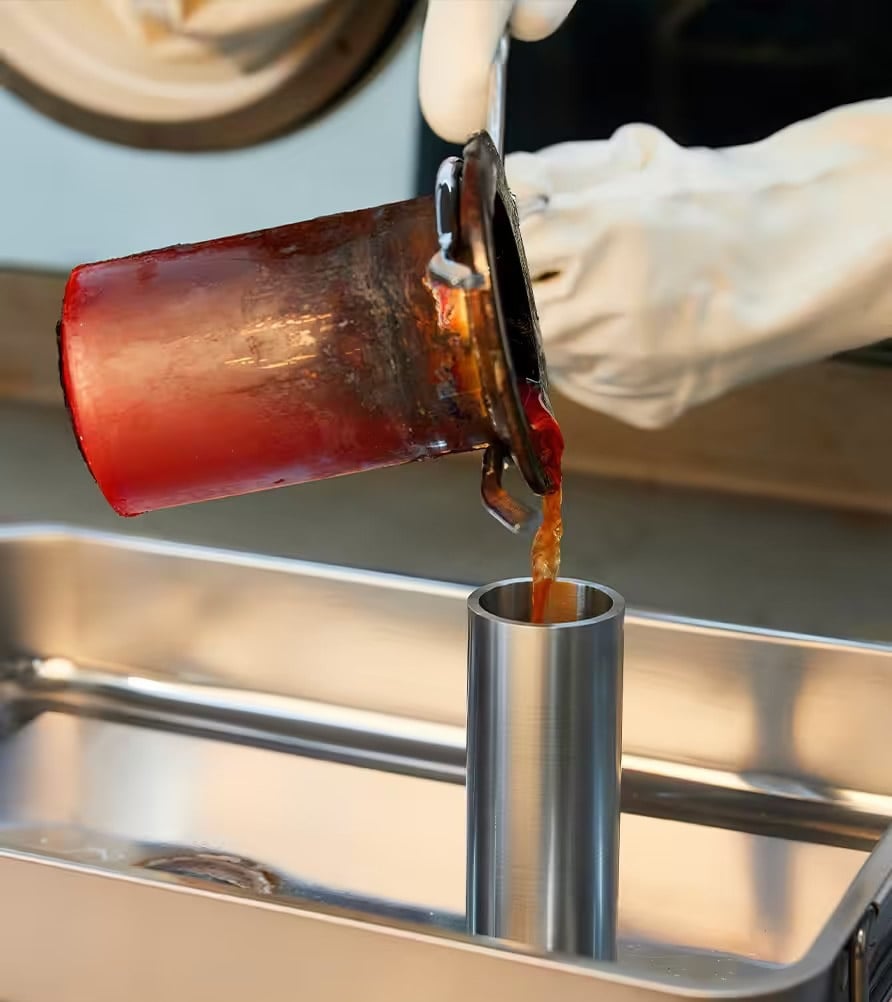
Copenhagen Atomics purified salts ships in ingots and tanks. Whether you need highly purified fluoride salts for a lab programme or highly purified salts at industrial scale for a running system, we ship pre-melted, no powder handling required.
There is around 10 times the amount of moisture uptake in the powdered salt compared to the ingot at each time interval, when exposing the various salts to air measuring the increase in the mass.
It is challenging to ship and handle salts in powder form without introducing moisture. The handling alone will introduce a large amount of moisture that will potentially result in 5 - 10 times more corrosion of steel.
Using Copenhagen Atomics high-purity salt results in significantly less corrosion when handled correctly*.
It would be more cost effective to use purified salts from Copenhagen Atomics and stainless steel 316 instead of powder-based salts and more expensive steels, such as Hastelloy N.
*Copenhagen Atomics will provide guidelines on how to handle the salt in order to minimize the oxygen content in your system during loading and operation.
Download: Salt Datasheets
A more technical and in-depth document
Choose datasheet to download
Interested in our molten salt products? Send us an inquiry and one of our specialists will get back to you shortly.
Molten Salt FAQs
What is the size of the machine (loop)?
Version 5.6 is 120x80x215 cm (47x31x85 inches), it cannot stand up against a wall or other equipment when it is operating. You need a minimum 20 cm space around the loop in order for the heat to dissipate. If you place it only 20 cm from a wall, then you must check that the wall material can handle the heat. See the datasheet for more information. Depending on your lab configuration you may also need space for a cold trap to remove moisture from the loop, a water chiller to keep the electronics cabinet cold and an argon pressure bottle if argon is not available from your lab piping. You may also need a transformer to convert your voltage to European voltages. See other questions below about voltages.
The loop can be rolled on a pallet pusher through most doors and into elevators.
What voltages does the loop need?
By default the loop uses a 32 Amp, 350 – 420 Volt, 3 phase European CEE connector. It can run on 45 – 65 Hz. American customers typically buy a transformer, which is readily available to step down American 480 Volt industrial supply.
Does the loop come with CE marking or UL marking?
The loops we sell in Europe come with CE marking. You can ask for our certification of conformity. For the US market, these are optionally fitted with UL approved cabling and electronics.
Can I use the loop as a pumping station?
Several of our customers use the loops as pumping stations, where they pump salt through some external equipment. Because molten salt compatible pumps are not readily available many of our customers simply use our loops as a pumping station. By using internal pneumatic adjustable salt valves, it is possible to adjust how much flow one wish to pump around in the internal loop inside the loop furnace or adjust a certain flow to go out through an external pipe assembly e,g, with reheaters, heat exchangers, measure equipment and more.
Can I connect two loops, to get very accurate flow measurements?
Yes you can connect two loops, each on a separate scale and in this way make very accurate flow measurements through the pipe connections
What is the maximum height that loop (pump) can reach?
The loop can deliver a maximum pressure around 2 bar. Depending on the type of salt it can reach 5 meters maximum pumping height. FLiNaK salt has a density around 2.2 depending on the temperature. Uranium and thorium salts have densities above 4 kg/liter. Most of the salts we use have a high change in density and viscosity with change in temperature.
How can we control the loop (from software)?
Copenhagen Atomics molten salt test loops come with control software which can be controlled from a webbrowser and the data recorded are also available in real time web data plots. You can control it from your computer or mobile phone as long as it is connected to the same LAN (WiFi) as the loop. Simple new commands can be set up within a few hours. The control software can also interface with other equipment. But this typically requires help from our integration engineers.
What interfaces are available to interface with the loop?
There are a number of ways to interface. The simplest is to get data out of the loop by using SignalR (a https protocol for near real type data reception). It is also possible to interface with Ethernet or RS485 or USB or 0-5V or 4-20mA typical industrial interfaces.
Get in touch
You will receive a confirmation email right away, followed by regular updates.