In June 1965, at Oak Ridge National Laboratory in Tennessee, a Molten Salt Reactor went critical with no solid fuel rods inside it. The uranium had been dissolved into a hot fluoride salt, and that liquid was pumped around in a loop. It ran on and off for about four years until December 1969. A decade before that, Oak Ridge had done something similar, running a circulating fluoride fuel reactor for nine days at up to 2.5 megawatts, all invented by Alvin Weinberg and his team.
Sixty years later, almost everything now called a Molten Salt Reactor traces back to that machine. The term has since stretched to cover designs that actually share very little with it, or with each other, which is where most people get confused. It is therefore worth being very precise about what the words actually mean. A Molten Salt Reactor is a nuclear fission reactor fuelled, moderated, or cooled at least partially by liquid salt rather than by water. That is the only guarantee the name gives you.
No, it’s not table salt
The first thing anyone wants to know is what the salt actually is. And no, it’s not the sodium chloride you’d find in your kitchen. The most common choice is a mixture of lithium fluoride and beryllium fluoride, otherwise known in the industry as FLiBe. Some might reach for sodium and potassium fluorides, or for chloride salts built around sodium and heavier elements. What they all have in common is a very wide liquid range. FLiBe melts at around 460 degrees Celsius and does not boil until it reaches a temperature of about 1400 degrees Celsius, and no salt of interest comes close to boiling at a reactor’s operating temperature.
That property is the reason these reactors exist in the first place. A conventional pressurised water reactor has to hold its water at a pressure of about 100 to 160 bar to stop it from boiling away at a temperature of around 300 degrees. A salt is already liquid at those temperatures, so that pressure isn’t needed and the reactor can run at atmospheric pressure. This removes the risk of a pressurised steam explosion. Salt carries heat about as well as pressurised water does, and unlike sodium, it doesn’t burn or react violently with water. In its molten state, it cannot be damaged by radiation either, because there’s no fixed structure left.
The most common objection that comes up against Molten Salt Reactors is corrosion. Like sodium cooled reactors, Molten Salt Reactors are sensitive to oxygen and moisture getting into the system, and both have to be held under tight control. If the salt used is treated correctly, corrosion is not a problem. This requirement for cleaning and purifying the salt is actually an advantage.
The process that keeps the salts clean is also what allows for the removal of fission products either continuously or in batches while the reactor keeps running. This results in a much better fuel efficiency than any solid fuel reactor and therefore has a direct impact on lower energy prices, resulting in less waste and material mining.
Three machines, one name
The label of Molten Salt Reactors essentially covers three different machines. The difference boils down to what the fuel is doing within them.
The fuel stays solid, the salt acts as a coolant: These are fluoride salt cooled high temperature reactors, or FHRs. The fuel is typically TRISO, uranium kernels around half a millimetre across, wrapped in layers of carbon and silicon carbide into particles under a millimetre in diameter, packed into graphite pebbles or blocks. Kairos Power is advancing its Hermes demonstration reactors in Tennessee to enable fuel replacement without shutdowns, with China’s TMSR-SF line expected to follow by 2030.
The fuel is a salt but does not move: Originally known as the Moltex reactor designs, these hold molten fuel salt in vented steel tubes arranged like conventional fuel assemblies. The fuel is liquid and stays inside these rods. A separate coolant salt flows past the outside of the tubes.
The fuel is dissolved into the salt: Fissile material goes into the solution, and the resulting fuel salt circulates through the core, carrying the fission reaction and the heat with it. Oak Ridge worked this way, as do Copenhagen Atomics, Natura Resources, Terrestrial Energy’s reactors, and China’s TMSR-LF1, the latter of which is currently in operation. All of these allow the removal of fission products, which is not the case in TRISO.
Because this category allows for such wide variations in design and performance, the widespread confusion around the topic is no surprise. Of the three variations, the third one is the most efficient, while the first is roughly on par with the light water reactors already running on the grid. Everything that follows concerns the third kind, because that is where the most interesting opportunities lie.
Fuel that flows
To understand why the liquid form of the fuel matters, it is important to look at what it’s replacing. A conventional reactor runs on ceramic pellets. Uranium oxide is pressed into pellets the size of a fingertip, stacked inside metal rods, bundled into assemblies, and lowered into pressurised water that both cools the core and slows the neutrons down.
Every one or two years the plant comes offline and roughly a third of those assemblies are replaced. Measured across the whole cycle, around half a percent of the energy in the mined uranium is used. The rest is wasted. In CA thorium reactors you can use 99% of the mined material as fuel.
A liquid fuel Molten Salt Reactor leaves the fuel rods out entirely. The fissile material is dissolved into the salt, fission happens inside a moving fluid, and because that fluid can be worked on while the reactor runs, the fission products that would otherwise poison the reaction can be drawn off and fresh material fed in without ever shutting down. Solid fuel does not allow any of this, and it is this one capability, more than the salt or the temperature or anything else, that changes the entire fuel cycle.
Built to control itself
The second consequence of a liquid core is added safety. Heat a liquid and it expands, in a Molten Salt Reactor, the expanding fuel spreads out and some of it is carried clear of the core, so that fewer neutrons find a target and the reaction slows of its own accord. No operator intervenes and no control system acts. It is simply what a fluid does when it gets hotter.
The Oak Ridge MSRE spent years testing this. Across more than 15,000 hours of testing designed to push the reactor, it never climbed fast or hot enough to trigger an emergency shutdown.
This is also the answer to whether a Molten Salt Reactor can melt down. The fuel is already molten, and there is no pressurised cooling water that can be lost, so the accident that happened in the past simply has no chance of happening here. That does not mean nothing can go wrong. Even after the reactor stops, there is still decay heat, and for this, the reactor needs a passive way to remove it, or the boundaries that hold the fuel could be breached and release radioactive material. A Molten Salt Reactor typically has three barriers between the fission products and the outside world. Despite being a newer type of nuclear reactor, it still requires containment, shielding, and a license from the country it runs in.
The limits are set by materials
The limits for Molten Salt Reactors are not really set by physics but by more mundane things, what it’s made of and how it’s cooled.
Molten Salt Reactors are generally designed to run between 550 and 750 degrees Celsius, against about 300 degrees for traditional pressurised light water reactors. Hotter is better, both because electricity is generated more efficiently and because at these temperatures, heat is directly useful. But the materials set the limit, and the limit currently sits below 750°C. Newer, more heat resistant materials exist, but they are generally more expensive and take a long time to get licensed and approved for nuclear reactors.
Another constraint that is almost never mentioned is cooling, and it deserves more attention than it gets. The heat has to be passed into a clean, non radioactive salt or fluid before it can be turned into electricity, which causes some losses, but the real loss is across the turbine, and that loss depends entirely on what is used for cooling. Where there’s plenty of cold water, seawater, for instance, the loss is smallest, 55% to 65%. Where there’s little water used or available, or only air, the losses in any power plant climb past 70%, and a conventional reactor running at 300 degrees on air cooling alone loses more than 80%. A Molten Salt Reactor is more efficient wherever there is water to spare, and, just as importantly, it does not become impractical where there is almost none. That is an advantage, and in a world short of both water and power.
Why is this the best option for the future?
While there are no thorium Molten Salt Reactors running in the world today, there is still an argument to be had.
Starting with the fuel, every known nuclear reactor needs to run on fissile materials and must be continuously fed to keep the reaction going. However, if you feed a reactor fertile material—such as thorium or spent nuclear fuel —and let it create its own fissile fuel as it runs, you no longer have a variation of an old machine. You have a different category of reactor altogether, one fueled with an abundant, cheap material rather than a scarce, expensive one.
A true breeder reactor can refuel with fertile fuel only. Plenty of designs call themselves breeders while their doubling time runs to the better part of a century and none of them can refuel with depleted uranium only.
Then there’s cost, which ultimately decides whether any of this matters. If a reactor is slow to build and more expensive than coal, wind, and solar, most countries will simply keep building those technologies, and the physics stays in the laboratory. The wager behind a mass-manufactured Molten Salt Reactor is the reverse: build the units on a production line, faster and cheaper than the alternatives, and let each one teach the next, and eventually most countries will want them.
However, none of this is proven yet. What makes it more than a theory, is that since the early 2000s, simulations have been good enough to estimate how a reactor design will behave before a single component is built, which is how we can talk seriously about a machine that doesn’t exist yet. The next real test arrives in 2028, when a one-megawatt reactor is scheduled to reach its first controlled chain reaction at the Paul Scherrer Institute in Switzerland.
Why is it important now?
The physics behind the reactor have been sitting on the shelf since the 1960s, so the obvious question is why any of it should matter this decade rather than the last one?
The answer is that electricity has quietly become the thing the world is short of. Consumption is rising faster than the grid was ever built to handle, pushed up by the electrification of almost everything and, above all, by the demand of data centres running artificial-intelligence workloads. The International Energy Agency expects global electricity demand to climb by more than three and a half percent a year to 2030, roughly two and a half times faster than energy demand as a whole, and most of that growth is in emerging economies rather than the West. The companies that need this power are among the best-capitalised on earth, and they want it reliably, around the clock, on timelines measured in a few years rather than a few decades.
That is a demand for firm power that wind and solar, for all their falling costs, cannot fully meet on their own. A reactor that runs day and night, can be built quickly and in numbers, burns spent nuclear waste and stays economical despite weather conditions, is aimed to fill that gap.
But this gap is the purpose only for the near-future. Step back far enough and this stops being an argument about reactors at all, and becomes one about what humanity has always done. Almost every gain in human prosperity has rested on getting more for less: clean water, preserved food, industry, medicine, the ability to build and move and cool and, now, to compute. Cheap, reliable electricity is not one product among many. It is the input to nearly everything else. A source of it that can be built in a factory and shipped anywhere, that runs day and night, that turns other reactors’ waste into fuel, would not simply add to the supply. It would change who gets to have it, and what they can afford to do once they do.
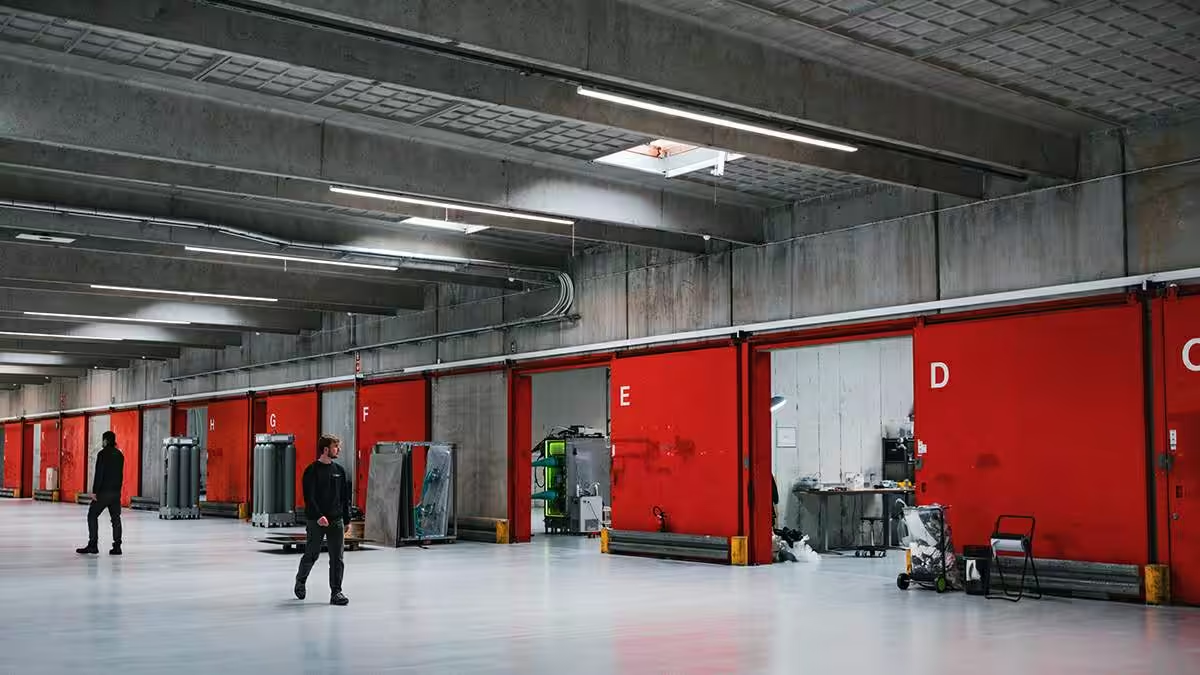
Copenhagen Atomics is not only building towards a better reactor, but one that is energy abundant and cheap enough to be treated as a given rather than a constraint. If the design proves itself, if the manufacturing works, the costs hold, and the 2028 demonstration does what the simulations promise, then it belongs on the short list of the largest shifts in energy in half a century, next to the handful of technologies that changed the world.
It isn’t there yet, and we are the first to say so. Most of these claims are still claims, waiting on further hardware and testing to turn them into facts. But the physics is there, the engineering is being proven one component at a time, and the need has never been this concrete. What’s left is the hardest and most ordinary thing in the world: to build it, and to keep building it, until the machine that ran only once, sixty years ago in Tennessee, becomes one that runs everywhere.