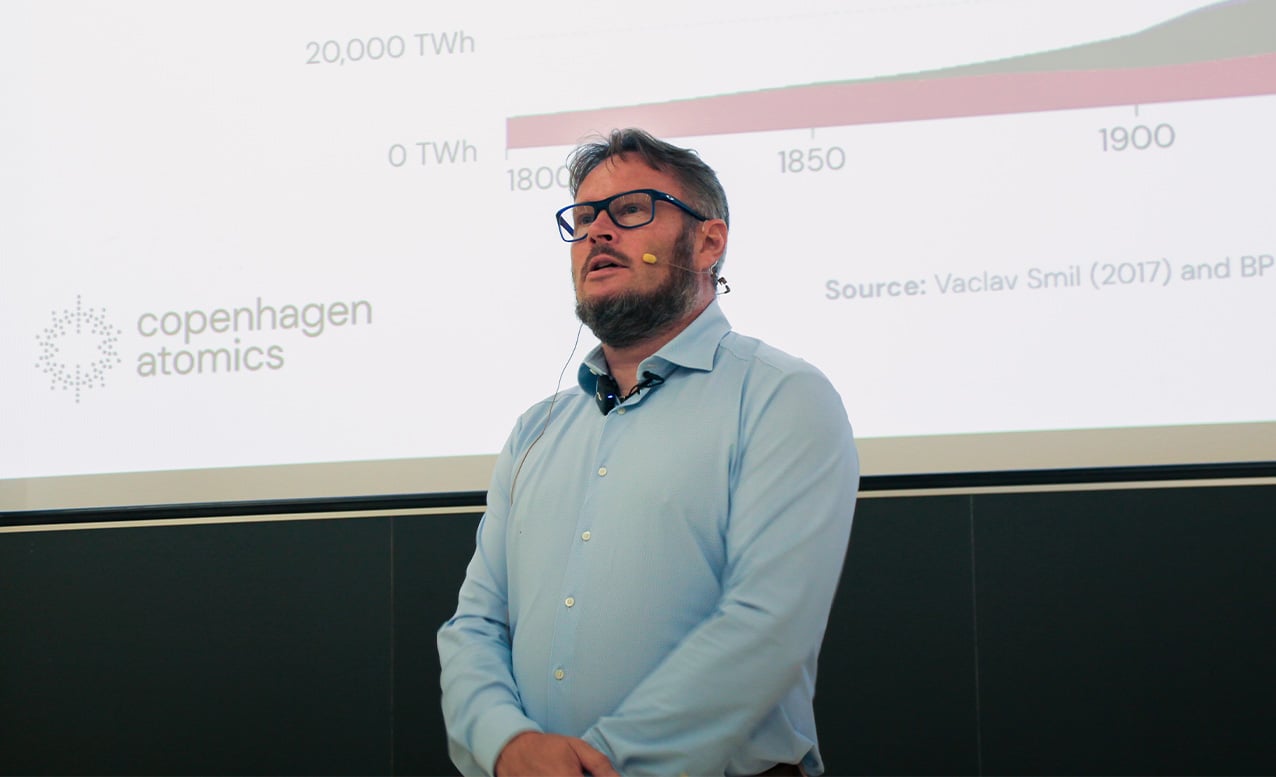
On 17 September, our CEO and co-founder Thomas Jam Pedersen gave the evening colloquium at the Paul Scherrer Institute (PSI) in Villigen. More than 70 people came, most of them PSI researchers and engineers. For a company whose next milestone will be built at PSI, there is no more demanding room to speak in.
Ten times more energy
Global energy use has grown roughly tenfold since 1925. Jam expects the next century to bring the same growth or more, and he does not think today’s sources can scale fast enough, or cheaply enough, to keep up. New technology has to close that gap. Whatever it turns out to be, it has to be cheap, and it has to scale.
Why thermal breeding needs thorium
CA breeder makes new fuel as it runs. In a thermal-spectrum reactor, where neutrons are slowed down and each one is far more likely to cause fission, only the thorium fuel cycle leaves enough spare neutrons to do this in practice. Thorium itself is a fertile element, not fissile. It absorbs a neutron and transmutes into uranium-233, which can undergo fission.
Our first units will start on low-enriched uranium as a kickstarter fuel salt surrounded by a thorium blanket salt. The blanket converts thorium into new fuel while the reactor operates, and transfers the newly created uranium into the fuel salt. As such, a reactor would need to add only a small amount of the cheaper fertile thorium to keep running.
More than 1,000x lower raw fuel cost
Thorium costs little per kilogram, and a breeding cycle gets far more energy out of each kilogram than a conventional reactor gets from enriched uranium. By our calculation, that puts the raw fuel cost per unit of energy more than a thousand times below solid uranium fuel. Raw fuel is one part of electricity cost, not all of it. Our target for the all-in cost of electricity is $30 to $40/MWh.