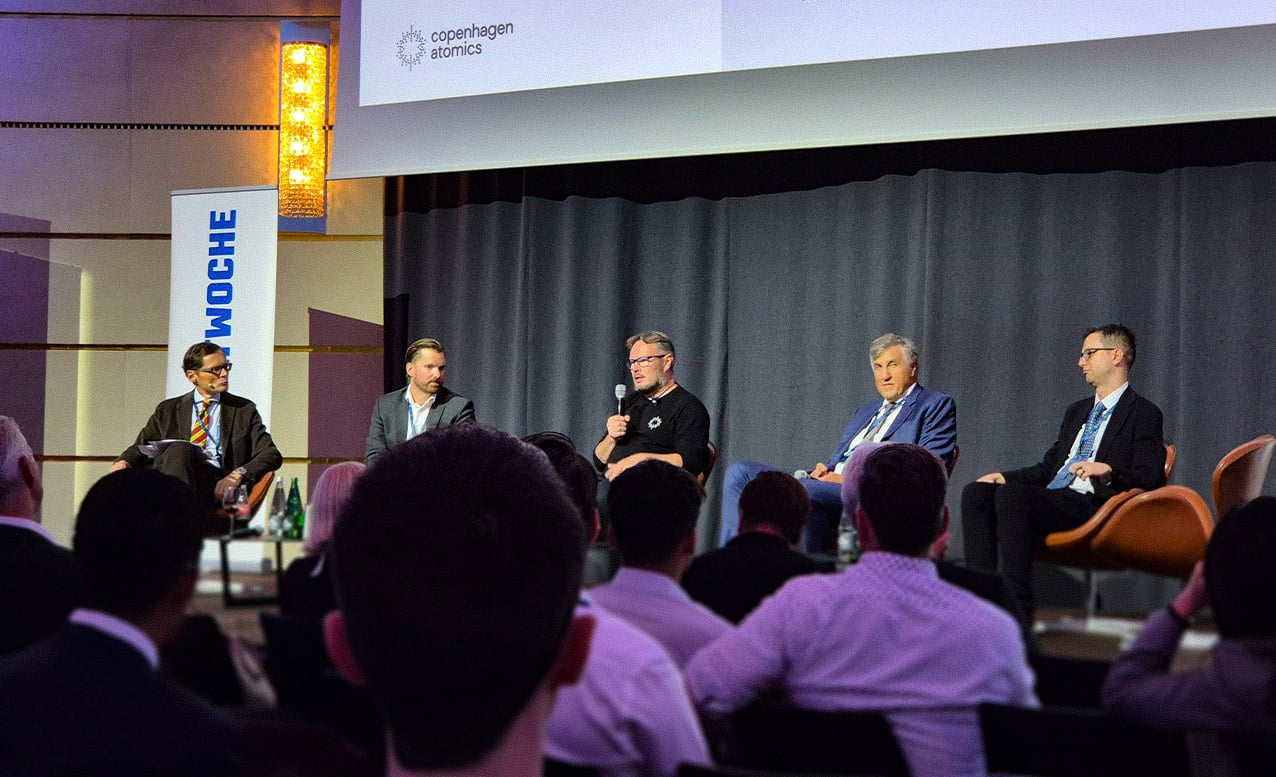
At Arnova Capital AG’s annual Nuclear Energy Summit in Zürich, our CEO and co-founder Thomas Jam Pedersen joined investors, family offices, and nuclear innovators to discuss the next generation of clean baseline power.
Across every presentation and hallway discussion, one central theme emerged: the world needs more energy, it needs it soon, and it needs it at a price nations and communities can actually afford. While the most recent nuclear projects in the United States have resulted in estimated prices around $150–$255/MWh and natural gas has a range around $51–$129/MWh, Copenhagen Atomics is targeting an all-in cost of electricity of $30–$40/MWh.
$10/MWh VS. $20-$30/MWh
Our financial model divides the all-in cost of electricity into two distinct components:
- $10/MWh Fixed reactor and fuel costs: Copenhagen Atomics supplies and owns the reactor and the fuel for the entire lifecycle of the plant, fixing fuel and reactor costs by contract.
- $20 – $30/MWh Plant owner operations: Covers the owner’s site, turbines, civil infrastructure, grid connection, licensing, and capital costs.
Because Copenhagen Atomics directly controls the design and production of the reactor and fuel, we can place a firm contract price on our $10 portion, while transparently estimating the owner’s remaining costs.
The four pillars behind our target
Cost-Effective Fuel: Unlike uranium, thorium requires zero enrichment. As a fertile material, it absorbs neutrons to create its own fissile fuel (U-233) directly inside the reactor. Thorium is three times more abundant in the Earth’s crust than uranium, with large quantities already sitting above ground as a byproduct of rare earth mining. We remain committed to partnering directly with active mining operations to secure a reliable, long-term fuel supply stream.
Sustainable Efficiency: Conventional reactors load, burn, and replace fuel on 1- to 2-year refueling cycles, exposing operators to ongoing fuel purchasing, enrichment logistics, and market price volatility. Copenhagen Atomics uses 5% enriched uranium fuel salt surrounded by a thorium blanket salt in designs targeting a breeding ratio approaching one. The blanket is designed to convert fertile thorium into fissile fuel while the reactor operates, so the plant owner is not exposed to enrichment capacity or fuel price movements. Over a closed fuel cycle our calculation is that a liquid breeder configuration can use up to 99% of the material it is fed.
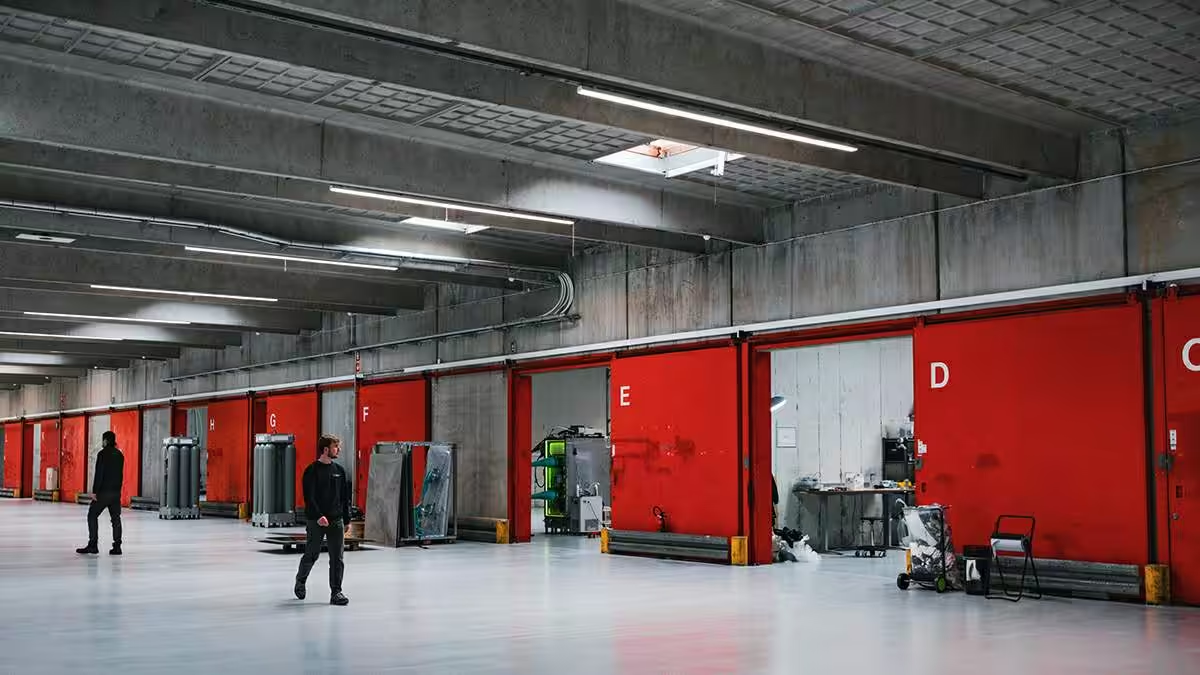
Mass Manufacturing: Traditional nuclear plants rely on 3 to 10 years of heavy on-site construction requiring a million tonnes of concrete and 50,000 tonnes of rebar. In contrast, each 100 MWth Copenhagen Atomics reactor is roughly the size of a standard 40-foot shipping container. Mass-produced on factory assembly lines and delivered via standard shipping logistics, our units are simply placed into position on-site—eliminating field reactor assembly entirely.
Compounding Scalability: Traditional nuclear projects routinely suffer massive budget overruns because every reactor is built as a custom construction project on-site. By replacing bespoke megaprojects with factory mass production using 31 identical, standardized modules for a 1 GWe plant we drive costs down through true industrial repetition.
We remain clear that $30–$40/MWh represents a target rather than a completed commercial measurement. Key upcoming milestones include:
- BALDER Critical Experiment: Our critical test loop at the Paul Scherrer Institute (PSI) in Switzerland, with initial testing expected in 2028.
- Regulatory Type Approval: Securing country-by-country type approvals so units are certified at the factory line rather than inspected into existence on site.
- Supply Chain and Material Durability: Scaling assembly lines and supply chains for salt, heavy water, and components, while validating material resilience under multi-year irradiation.
Proven Engineering Foundation Today
While commercial fleet operation lies ahead, our engineering foundation is firmly established:
- 440+ years of accumulated component operation across continuous test loops as of August 2026.
- Two full-scale non-fission prototypes completed (2023 and 2024), with a third currently under construction.
- 13 active patent families and commercial sales of salts, test loops, and testing services to universities and national laboratories worldwide.
Copenhagen Atomics is proving that affordable, clean, scalable nuclear energy is an exercise in industrial standardization and engineering.